E-Commerce

E-commerce Definition
E-commerce refers to the process of buying and selling products and services, as well as transferring money and information needed to complete transactions over the Internet. The term e-commerce is often used to describe the sale of tangible products over the Internet, but it also includes any business transaction that is facilitated by the Internet.
E-commerce terminology
The following are the most important terms of e-commerce marketing, and e-store management.
Affiliate Marketing
Affiliate marketing occurs when a producing company hires another company specialized in marketing and advertising to market a specific product to consumers and customers, for a fee or a specific percentage for each sale.
Shopping Cart
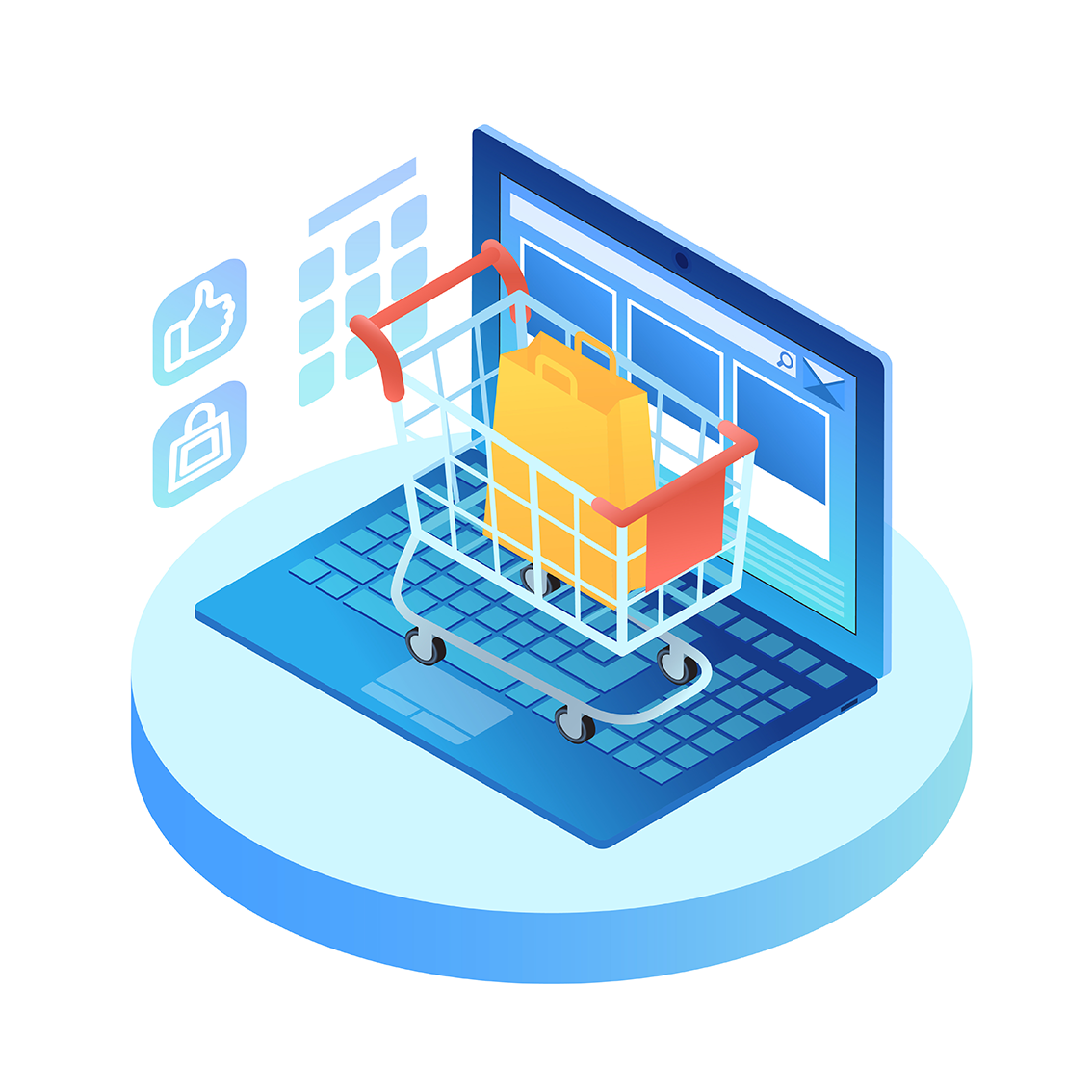
When you go to a traditional store, the first thing you do after entering the store is to get a cart or basket to collect the products you want to buy, and the same thing happens when you shop online, all you have to do is browse the online store and add the products you want to the basket electronically, to purchase and pay for it.
Checkout
It is a process during which the customer checks the contents of his basket, after the end of the shopping process, in order to pay for it.
Payment Methods
Electronic payment platforms play an important role in online stores, and their role is summarized in two main things:
Facilitate and speed up the payment process.
Cart Abandonment
This situation occurs when a customer visits the website of the online store, puts products in the basket, and then leaves without buying them for one reason or another.
Cross-selling
It is selling additional products or services to customers after they purchase certain products, that is, it includes encouraging existing customers to buy products that complement the product they want to buy, and this method is frequently used in electronic retail stores.
Customer Lifetime Value
It is a measure used to estimate the total value (or gross net profit) that an e-commerce company gets from a relationship with a particular customer over the long term.
-1642928655.png)
Discount Rate
It is a percentage imposed by the beneficiary banks in return for facilitating the merchant's transactions. The discount rate usually represents a small percentage of each purchase, but the value of this percentage depends on a number of factors, such as the type of card used, the order mechanism, and whether or not there are systems to verify the identity and address of the card holder.
Retail or dropshipping
Dropshipping is a type of e-commerce that involves shipping products directly from the factory to the customer, without storing them.
Order Fulfillment
This term expresses the series of steps that a company takes to meet the demands of its customers, starting from collecting these requests from points of sale, and ending with the delivery of products in a way that achieves customer satisfaction.
Fulfilling orders is very important, which requires a specific mechanism to carry out these tasks, especially when the company receives a lot of orders. It should be noted that many small and medium-sized companies and e-commerce companies assign these tasks to other companies specialized in this field.
Inventory
Inventory refers to the amount of goods and products currently in the company's warehouse waiting to be sold. Inventory follow-up is very important, so that the company does not promote products that it no longer has, and inventory monitoring helps detect inventory shrinkage and determine minimum orders.
Key Performance Indicator
A key performance indicator is a measure that helps companies evaluate their success in achieving basic goals. This measure is divided into two types: a high-level performance indicator, which focuses on the company's performance in general, and a low-level performance indicator that studies the performance of specific departments, such as (for example) sales. , marketing, and call center for customer service.
Marketing Funnel
The marketing funnel refers to the customer's journey with the company, from their introduction to the company, to the point of purchase, and beyond.
Monthly Recurring Revenue
This term refers to the revenue that the company may collect on a continuous monthly basis, which is also called the term "expected revenue."
This concept is especially important for companies that rely on monthly subscriptions, and the recurring monthly revenue can be calculated in this case by multiplying the number of subscribers by the average revenue that the company gets from each subscriber.
Social media advertising
Posting advertisements targeting social media users. It should be noted here that various social media platforms use users' information and their activity on their platforms to display advertisements related to them and their interests.
Pay-per-Click (Pay-Per-Click)
It is a type of advertising in which the advertiser pays only when they click on their ad, successfully directing a potential customer to their site. Google Adwords is the best example of promoting in this way.
Return on Investment
It is a measure of calculating the profit or loss of an investment compared to its cost. This measure is usually expressed as a percentage. It is used to make financial decisions, measure the company's ability to generate profits, or balance different investments.
Upselling
It is a selling technique that aims to persuade the customer to buy an additional product or a high-priced product while purchasing another product. This method relies on offering the customer other options that he might not have considered, in order to increase the profits of the transaction.
This method includes trying to sell products with better specifications than the product the customer is trying to buy, selling an upgraded or more expensive model of the same product, or persuading the customer to buy other add-ons related to the product he wants to buy in the first place.
Business to Business
It is the process of exchanging the sale of services or products between companies with each other, and they are often modified or divided and sold to the consumer.
Business to Consumer
Selling products or services from companies to customers directly.
Consumer to Business (C2B)
This type of e-commerce is defined as the process of exchanging or selling business between the consumer and companies, as the consumer provides or offers business and presents it to companies, where companies use these businesses to complete a business process or gain a competitive advantage, for example, a person can Design a program that serves the interests of a particular company, and then sell the program to that company.
Call-to-Action
It is a call to persuade users to take a certain action, such as “Shop now, buy it today, get a discount now” or any other phrase that aims to get the audience to do a certain thing.
Conversion
Conversion is one of the most important components of e-commerce, and it refers to the process of converting a user into a customer, but this term does not necessarily refer to a financial transaction or a sale, it may take other forms, such as the user requesting a price, filling out a contract form, or ordering a specific product .
Conversion Funnel
Often referred to as the 'sales funnel', it is the path that an online store visitor takes from the moment they enter the site to the conversion process. The term "repression" is used to describe this process, because it can be accessed from multiple entrances, but it eventually leads to the same point, which is the transfer, which is the point that the promoter aims to push the customer to reach, and this is represented in purchasing the commodity or subscribing to the service or any other Another approaching process that eventually leads to profit from clients.
Cookies
They are text files that the website sends to the user's browser, which include how the user interacts with the website. In most cases, visitors to online stores receive a request to allow "cookie sharing", and if they agree to this, the information in these text files is sent back to the site and used for marketing purposes. This information usually includes the pages the visitor visited, the type of device the visitor is using, the city of the visitor, the time and duration of the visit and other information.
Cyber Monday
It is the first two to come after Black Friday, and this day has more offers and discounts than any other day of the year, and some even claim that Cyber Monday has surpassed Black Friday in terms of sales over the past few years.
Black Friday
Black Friday comes the day after Thanksgiving in the United States, and this day is marked by many offers and huge discounts. It was noted that the Middle East region is affected by these seasons and the sales movement increases. And you can take advantage of this period to better display your products through offers and coupons.
The importance of e-commerce
E-commerce is gaining increasing importance in the global economy, as it has become an essential part of companies' business strategy, and a strong catalyst of economic growth.
The continued expansion of e-commerce can contribute to preventing inflation, by increasing competition, saving costs, and changing pricing behaviors of sellers.
Companies of all types and sizes, from start-ups, to small and medium-sized companies, and even large brands, are now able to launch online stores to sell their products and services.
Thanks to modern technology, consumers of all age groups have come to expect companies to provide them with easy and convenient services that fit their daily lives. Creating your own e-commerce website is the ideal platform to launch your business and better showcase your products and services.
Forms and types of e-commerce
Business to Customer (B2C)
Which is for companies to sell their products directly to the end user. This is the most common form of e-commerce, and therefore many different methods fall under it.
In contrast, the decision-making process in this type (i.e. making a purchase decision) is much shorter than the decision-making process in the case of B2B sales, especially in low-value products.
Corporate to Business (B2B)
It is for the company to sell its products or services to another company. Although the buying company may be the end user of the product, companies often buy the product with the aim of re-manufacturing it, or reselling it to the final consumer.
Although this type of e-commerce involves a longer sales cycle, the value of orders is greater, and sales are more frequent.
Corporate Consumers (C2B)
This type of e-commerce allows individuals to sell their products and services to companies.
Elance, which now bears the name (Upwork), is one of the first leading companies in this field, by providing self-employment services provided by individuals to companies.
Consumer to Consumer (C2C)
In this type of e-commerce, companies connect customers and allow them to exchange goods and services, in return for a specific fee from either party.
Craigslist and Ebay are among the first leaders in this field.
Comparison between e-commerce and traditional
|
Compare |
traditional trade |
Electronic trade |
|
the definition |
Exchange of products and services at the point of sale |
Executing commercial transactions and exchanging information electronically through the Internet. |
|
Financial transactions |
manual |
mechanism |
|
Accessibility |
Limited to a certain time |
It works around the clock 24×7×365 |
|
Product preview |
Products can be previewed before purchasing. |
Products cannot be previewed before purchase. |
|
Interact with the customer |
face to face |
By default through the screen of the device being used |
|
work area |
confined to a specific area. |
Reach all over the world |
|
Exchange of information |
There is no unified platform for exchanging information |
Provides a unified platform for information exchange |
|
resource concentration |
Focus on presentation |
Focus on demand |
|
Relationship with companies |
Linear inelasticity |
integrated |
|
Marketing |
One-way marketing targets the group, not the individual |
Focused Personal Marketing |
|
paying off |
Cash, checks, credit cards, etc. |
Credit Cards, Cash on Delivery, etc. |
|
Products delivery |
immediately. |
It takes time for the product to reach the customer. |
E-commerce features
• Brand Expansion
E-commerce is the best way to transform your traditional brand into an innovative and likable one.
• Ease and convenience
The online store is open all day long, which means that customers can visit your store at any time.
• Increase reach
The Internet allows millions of people around the world to visit your online store at any time of the day or night, which means that e-commerce is a great opportunity for business owners who seek to reach a wider audience.
• Increase marketing opportunities
Online stores are one of the most important marketing tools that any company can own.
• Possibility of development
As your company grows day by day, you will need to increase the ability of your products to reach a wider audience, as well as improve your company's ability to meet the increasing demands of consumers.
Advantages of e-commerce
• Exceeding geographical boundaries
If you own a physical store, it means that you can only provide services for a specific geographic area, but if you own an online store, the whole world is available to you.
• Lower costs
One of the most tangible advantages of e-commerce is the low costs. Lower costs also benefit customers, as this allows online store owners to make offers and sell products at low prices.
• Find the product quickly
The consumer no longer needs to push the shopping cart around the store in order to find the product he is looking for, as online stores allow finding the desired product with the click of a button or the click of a mouse.
• The ability to compare products
E-commerce facilitates the process of comparing products while shopping, and allows customers to browse different stores and find the best prices.
• abundance of information
Online stores provide customers with a lot of information that they can easily access, knowing that providing this information does not cost sellers anything at all.
E-commerce goals and benefits
• Reducing administrative costs
E-commerce helps companies reduce administrative costs, and thus improve revenues.
• Develop business relations
E-commerce allows the development of commercial relations between the company and its customers, thanks to direct communication between the two parties.
• Giving customers a unique experience
If you want to differentiate yourself from the competition, you should make sure to provide a unique experience for every customer who visits your online store, website, or mobile app.
• Increasing the effectiveness of services
E-commerce allows improving services provided to customers, such as reducing delivery time, facilitating financial transactions, providing support through text conversations (chat), and so on, which in turn is reflected in the level of customer satisfaction.
• Increase Sales
If you want to grow in the world of e-commerce, you should strive to increase your sales constantly, and all other company goals should serve this goal. It can be said that increasing sales will remain the permanent goal that all e-commerce companies seek.
E-commerce fields
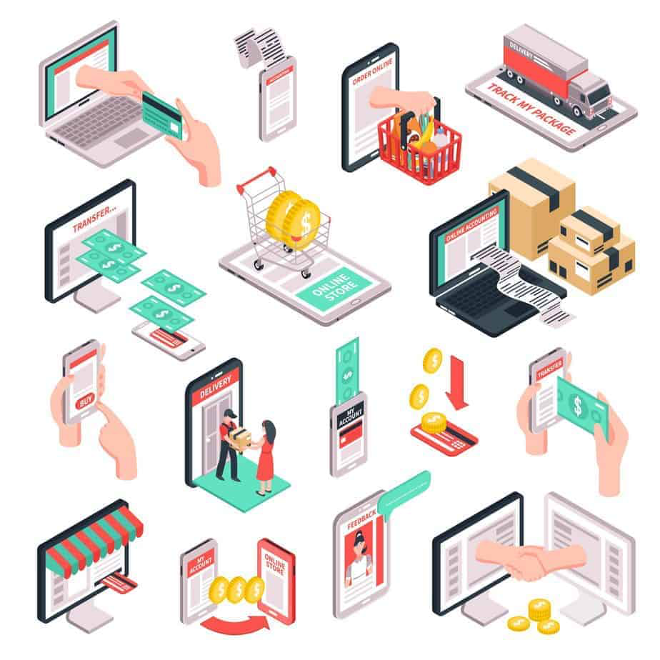
The term e-commerce is a broad term, as it is not limited to large companies, but almost anyone can enter this field and build their own online store, and e-commerce has already covered many different sectors, such as the health sector, education, tourism, and others. . Here are some of the main areas of e-commerce:
• Education through e-learning
• Health through telemedicine.
• Tourism and travel by booking hotels and managing trips and holidays online.
• Entertainment through movie sites, games, betting sites, and so on.
• Services through electronic brokerage, and online ticket booking.
• The financial sector through electronic banking services.
In addition to the above main areas, e-commerce has had a significant impact on other sectors, such as (but not limited to) electronic publishing, electronic auctions, electronic advertising, and so on.
Marketing in e-commerce
E-commerce marketing aims to increase public awareness of the company, and help it sell its products and services. This marketing takes many forms, including: Social Media Marketing, Content Marketing, Search Engine Marketing, Email Marketing, Influencer Marketing.
Social Media Marketing
All companies and advertising agencies today seek to build their own pages on the most popular social networking sites, with the aim of communicating with the audience and publishing content that attracts their interest.
Content Marketing
When you hear the word “content marketing” the first thing that comes to your mind is videos and blogs published by companies, but the concept of content is much broader, it includes all content aimed at improving the visibility of the company’s website in search engines, and answering customer questions related to its field of work.
Search Engine Marketing
Although SEO depends on your knowledge of Google’s search algorithms, and your ability to use them to raise your site’s ranking in search results, you can also pay for the first ranks on the results page.
Email Marketing (Email Marketing)
Email marketing (email marketing) is one of the oldest forms of digital marketing, but believe it or not, this type of marketing still occupies an important place in the world of marketing and e-commerce. Since at least 99% of consumers check their email on a daily basis? This percentage is not found in any other channel of communication.
Email marketing is an effective digital marketing strategy, which involves sending messages to customers via email, with the aim of converting potential customers into actual customers, and converting actual customers into permanent fans of the company and its brand. Also, email is secured and your own property, and no one can take it from you.
E-mail is also an effective means of permanent communication with your customers and studying their reactions, and makes a good impression on you among customers. So, in the email, assign a signature that includes your brand and e-commerce.
Influencer Marketing
In this type of marketing, companies rely on famous personalities or reputable brands who are able to influence their target market.
Challenges, obstacles and problems of e-commerce
If you own an online store, you may feel that managing it is more difficult than managing traditional stores, and you may be right. Online stores follow different rules and laws, and cyber security has become very important for the survival of your store.
Security
E-commerce companies need strict policies and procedures to protect the company's cyber security.
The competition
Competition takes many forms in the world of e-commerce, especially between small companies, so if the online store wants to succeed, it must lead the competition in prices, products, and services.
customer experience
Every e-commerce company should figure out how to give its customers the opportunity to enjoy the same experience that they get when visiting traditional stores.
Convert visitors into customers
If designing an online store and then managing it is difficult, then converting visitors into customers is much more difficult, as statistics show that the average conversion rate globally does not exceed 3% of the total number of visitors.
Appear
How do you get traffic, and convert visitors into customers, if customers aren't even able to find your store? Therefore, e-commerce companies should take care of this problem, as it may make the difference between success and failure.
The impact and risks of e-commerce on the market and society
The most prominent effects of electronic commerce on the economy are its impact on production and inflation. The continued expansion of electronic commerce may prevent inflation, by increasing competition, reducing costs, and changing the pricing behavior of sellers. However, e-commerce also has some risks and negative effects, including:
The unemployment
Some companies move from being traditional companies that own stores in the real world to electronic companies that sell their products through the Internet, which leads them to abandon the workers who used to work in those stores.
Privacy
Online stores can collect a lot about their visitors, using electronic tracking tools called cookies. These tools collect detailed information about the browsing patterns of visitors, which enables e-store owners to design advertisements targeting consumers according to their preferences and needs. On the other hand, some critics believe that these activities constitute a violation of the privacy of customers.
Security
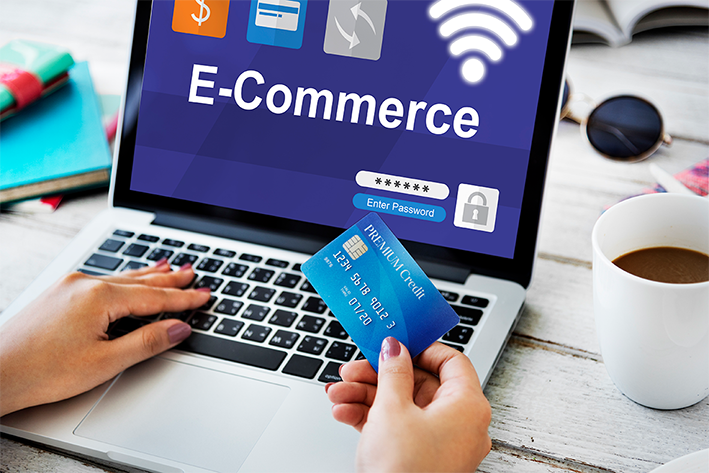
When you shop online, you usually enter your credit card number, and other personal information, but the risk lies in the possibility of some people exploiting the vulnerabilities in the systems and computers of online stores in order to access this information. However, it should be noted that e-store owners have become more vigilant and keen on information security than they were in the early days of e-commerce.
How e-commerce is changing the shopping experience
To keep pace with increasing customer demands for more choice, easier access, and faster delivery, companies are integrating their in-store and e-commerce offerings to create seamless, multi-channel shopping experiences in which customers can find and explore online products and services before making a purchase either online or in-store
Try on in-store items through interactive kiosks, personal guides, and other offerings before making a purchase either online or in-store.
Use any device - computer, smartphone, smartwatch, digital assistant, and more - to shop whenever and wherever they want
Receive tailored recommendations, coupons and other online offers based on information collected online or in-store.
Ship items wherever they want (to their home or their local store), often in just a day or two,
Ordering items online from within a traditional store, when that physical store lacks preferred stock (style, size, color, etc.)
In the end, we can say that e-commerce includes all electronic markets that link sellers and buyers, and the Internet is used to carry out electronic transactions.
Before choosing your appropriate field, you should first think about the nature of your business, the type of business dealings suitable for it, and your target audience. You must specify which category your project falls into: Business to Business (B2B), Business to Customer (B2C), Customer to Customer (C2C), or Customer to Business (C2B)?
It is important to be familiar with all aspects of e-commerce to achieve the success you desire.
 EN
EN


