Distance Education And Digital Technology

According to ITU statistics from 11 Arab countries, more than 50% of Arab households have a computer. which means that there is great potential for the Arab tele-education sector to flourish, Especially after the total and partial shutdown caused by the Coronavirus outbreak that stopped 1.6 billion students from studying last year which led many of them to go to e-learning, The establishment of a distance education platform has made it an urgent necessity and a successful investment with a promising future.
Digital transformation has swept the arena, with distance education no longer an option, but a reality that rivals traditional education, especially with more than 6 million distance learners around the world and a growing demand for virtual teachers, which will lead to competition among e-learning platforms, and there will be an urgent need to know how to create a distance education platform.
What is distance education Distance Learning?
Distance Learning is one of the modern methods of education based on the use of the digital technology of the Internet and means of communication in sharing knowledge with other "scholars," also called E-Learning. Distance education is generally an educational pattern that does not require personal attendance during learning.
In its overall concept, it is the kind of learning in which all modern and traditional communication devices are used, including most common concept today, education is based on the use of the Internet via smartphones, tablets and computers. It is telephone, television, radio, etc. In its own and
:divided into three sections:

1. Synchronous Education
Simultaneous education is the least flexible, as it requires the presumptive attendance of the learner at the same time that the teacher is present through visual, vocal, or written lecture techniques through an electronic learning platform, as there is a pre-planned direct connection that enables interaction and participation in the subject offered.
Blackboard Collaborate is one of the best options for sharing files, interacting and attending meetings, knowing that it requires a certain limit on the number of learners per Webinar virtual meeting depending on the type of tools used for the meeting, whether paid or free, there are telephone applications and websites. Another requires that the number should not exceed 10, such as Google Hangouts.
2. Asynchronous Education
In asynchronous education the learner receives a scheduled education with certain dates, to deliver the list of lessons, explanations, and homework on a weekly or fortnightly basis, allowing him or her access at any time to the material offered on the educational platform. His photographs include:
• Open Online Courses
Open courses are suitable for those who have tendencies and readiness for self-learning by making a double personal effort, as the teacher gives his students a set of knowledge resources such as books, videos of him or others, files, pictures, audio, addresses of electronic libraries, study and research centers, etc. The student only has to strive to achieve and prepare for exams in an open and long-term time frame.
• Programmed courses online courses
Programmer companies are prepared in earlier programmed circles.
3. Hybrid or mixed education
Hybrid education is a pattern that combines both synchronous and asynchronous types. It is loved by many due to the multiple options it provides, which gives more scope for both parties, whether the teacher or the learner.
There are tools that help to organize time and quickly upload and share files over the Internet, which the teacher and the learner need to make the distance education process successful, most notably:
• The Anna tool is suitable for groups that interact with each other via the Internet from a distance, including students and the teacher.
• Google Drive service that allows cloud storage and file sharing over the Internet.
• Google Calendar service that helps in scheduling tasks and appointments.
The difference between distance education
and traditional education
1. Higher education quality
Traditional education is not necessarily bad, but it may be better sometimes, but the point is that there is continuous fierce competition between educational platforms, which means competition to provide the best services and hire the most skilled and efficient teachers and trainers to stay in the lead, because the returns are linked to performance unlike traditional schools. Especially the government, which guarantees its income either from the state’s public treasury or citizens’ taxes, for example.
2. Low learning costs
Compared to the costs of universities and traditional schools, the costs of distance education are much lower, especially with the absence of transportation, food, and other costs.
3. Download lessons and training courses
In distance education, you can download educational materials, whether free or paid, and benefit from them in the event of an internet outage. The knowledge that is taught in the form of visual content is easy to assimilate, due to the influence of visuals on the human brain more than written or audible elements. Sometimes you may watch a video despite its length, but it sticks in your memory, while you may not remember a single line from a book you read!
4. Reducing stress
In distance education, the feeling of psychological pressure that may increase in traditional education decreases due to the large number of exams, bullying, and the weakness of some teachers.
5. Flexibility and creativity
Distance education gives the learner room for creativity, greater freedom than traditional education, and a global digital space that allows learning by and only the best teachers, and to meet colleagues of a high level of education from all over the world, benefit from them, build strong relationships with them, and meet with them virtual or online Private groups and discussion about the domain.
6. Certificates
Distance education allows obtaining printable certificates that are internationally or locally recognized, sent via e-mail or other methods, giving the learner a sense of superiority and entitlement like a traditional student.
7. Keeping pace with development
Companies that use electronic educational platforms to develop their employees achieve maximum keeping up with the latest knowledge in their field of activity easily and smoothly, unlike companies that rely only on traditional educational methods. Distance education allows the optimal exploitation and benefit of digital technology, and encourages others to use it.
8. Save time and effort
Unlike traditional education, distance education saves time and effort that may be wasted in transportation to the university or school, and shortens distances.
What is meant by a distance learning platform?
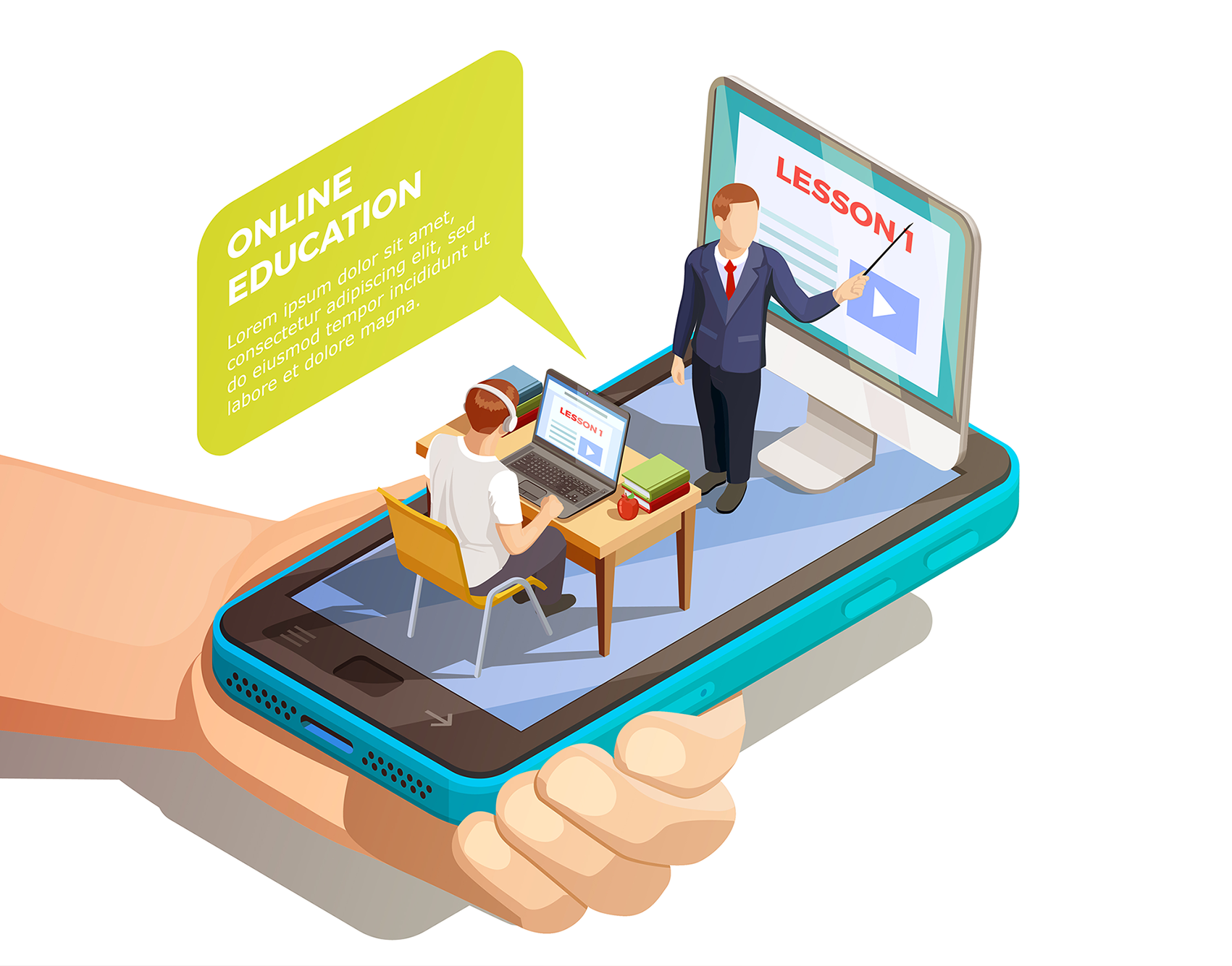
After I realized what distance education is and its types, we now know a term closely related to this type of education, the distance education platform, which is a digital platform represented by a website where informational content is available, providing a virtual meeting place between the educational service provider and the recipients “clients/students”. You can create a distance learning platform from scratch, or just open a special account on one of the popular open source educational platforms such as Docebo or Udemy.
The importance of creating a distance education platform
Among the advantages of creating a distance education platform:
First: For the platform owner and remote teachers
1. Successful investment
The creation of a distance education platform brings excellent returns. The market size of the distance education sector has an upward economic trend. According to Forbes, the distance education market is expected to reach 325 billion US dollars by 2025.
2. Money Economy
The cost of creating a distance learning platform is negligible compared to the costs of the traditional education system, because you will not need a huge capital to build a private school or university, then equip it with classroom equipment, pay electricity, gas, and water bills, bear the costs of periodic maintenance, and sponsor Transferring students, feeding them, paying teachers’ salaries, and so on.
All you will need is some money to buy Hosting and Domaine if you decide to create a distance education platform from scratch, but if you register via an open source e-learning platform, you will have to pay an annual or monthly subscription, and no matter how high the value of this subscription, you will not be more than the cost of setting up an attendance school or university.
3. Larger customer base
In traditional education, the number of students is limited, and will not exceed a few hundred at most, unlike e-learning platforms whose customer bases are estimated at thousands or hundreds of thousands, which means more profits, and continuous attraction of new audiences, especially if you seek to create a multilingual distance education platform .
Second: For clients/students
We have previously reviewed the advantages of distance education for its entrants and its importance for them in saving time and effort, keeping pace with development, ease of access to educational materials, and lower cost. In addition, the creation of a distance learning platform enables its enrollment to:
Global Reach
Anyone from anywhere in the world can access and register for the distance learning platform, and start learning without geographic or legal obstacles such as those imposed on immigrant students.
What makes a distance learning platform a sustainable option for the future?
There are several factors and indicators that make the establishment of a distance education platform a sustainable option in the future. We mention the most prominent in the global community:
1. The demand for digital devices
The psychological ability of many people today to use a smartphone, computer, and other digital devices is more than their ability to browse through paper books, in addition to the ease of using writing and writing programs such as Microsoft Word or Google Docs synchronized cloud service, unlike handwriting with a pen.
2. Epidemiology
Experts’ expectations that new epidemics will spread faster in the future, and the possibility of repeating the scenario of partial and total closures that occurred in many countries of the world in 2020, promise that distance education will be the appropriate option for many years to come. In addition to global climate change, disruption of the animal ecosystem, and weakening of human immune systems due to unhealthy habits that have spread among many people, such as smoking, staying up late, eating saturated fat and so on.
3. Dissemination of 5G technologies in the future
Distance education will be positively affected by the changes in the Internet that will be supported by the Internet of Things (IOT) after the popularization of 5G technology around the world, and the entry into service of the Star-Link Internet for All project with unlimited speeds and lower cost, which will make the possibility of creating a distance education platform available For everyone, given that half of the third world countries do not have a distance education coverage rate that exceeds 50%, according to the United Nations.
4. Remote teacher function
The online tutor job will be one of the most important, if not the most important, jobs of the future. Since education is the pillar and base of everything.

How to benefit from creating a distance education platform
There are several systems available through which you can benefit from creating a distance education platform, we review them below:
1. Paid subscription system
In the paid subscriptions system, you will have to communicate with universities, institutes and companies, and invite them to educate their students and employees through your educational platform, in return for paying annual, semi-annual, or monthly financial subscriptions, to ensure long-term subscriptions, as well as for individuals wishing to subscribe.
2. Free upgradeable subscription system
The upgradeable free subscription system allows you to provide free educational and training courses, and at the same time it allows you to upgrade your free subscription to Premium to take advantage of additional privileges and services.
3. Advertising to others
The goals of creating a distance education platform are not limited to profit from subscriptions, but also go beyond that to the possibility of advertising to others, whether they are professors and teachers marketing for themselves or active advertisers in the field of distance education marketing their services or training courses through your online platform. You can rent advertising space on your platform for a set amount, which is an idea similar to the idea of a classified ads site.
Steps to create a distance learning platform
Creating a distance learning platform is not as complicated as some might think. So, we review in a simplified way the following are the most prominent steps that you can follow to create a distance education platform:
1. Find the right idea and select the added value
Like any business project, you will need to know the appropriate field in which your electronic platform will specialize, or what is called in the business world as Niche, because the fields vary according to the volume of demand for them in the distance education market, and the demand for some fields increases more than others, such as the field of programming education or graphic design through the Internet. distance. You can find out by the search volume on a keyword related to a domain in the geographic range you specify via tools like SEMrush.
After determining the appropriate idea, you should try to distinguish from competitors, which is called creating a competitive advantage. Entering and staying in markets goes through stages of intense competition, and this competition revolves around several points:
• Who will provide the best added value to customers? This includes providing an excellent user experience to the customer.
• Studying competitors by determining their number, size, strengths and weaknesses to exploit them, through SWOT analysis.
• Who will be keen to find solutions to existing problems in the field? To stay closer to the customer, and to have a deeper understanding of the target audience.
These themes that we mentioned are one of the most important elements of the process of studying the market and understanding the target audience, starting with defining the appropriate idea, trying to provide an addition to customers, analyzing competitors, and ending with searching for ways to outperform them by creating a competitive advantage to overtake them.
Reducing the number of students in one virtual class may help you to outperform your competitors, so that the students’ absorption is more, and so that the teacher does not make a double effort in the event that the large number of students on the electronic educational platform hinders him from supervising the assignments, preparing and correcting tests.
This is what you will understand after studying your competitors’ platforms, looking at written or visual reviews of their customers, and by doing electronic surveys to improve the user experience, so if we assume that your competitors are accrediting 30 students in one virtual class, you can reduce the number in your classes to 20 students and so on.
In general, seeking to create a platform for distance education without specifying what it will offer of new features, creative ideas, and offering practical solutions, is not a wise act. Therefore, it does not go beyond the first stage on which all subsequent stages will depend, but rather it is more important than the technical stages.
Now you have to think about the necessary elements and features to satisfy your future users such as:
• Providing technical features that enable teachers to monitor students' performance and results.
• Determine the type of virtual classrooms and the number of participants in one meeting.
• Ensure the design of a good user experience (UX), especially the design of the user interface (UI) simple and easy.
• Providing the feature of creating internal groups for students or teachers within the educational platform and the feature of group discussions.
• Establishing strict criteria for teachers to select knowledge sources with great caution and scientific honesty, to improve the quality of distance education.
• Platform compatibility with different digital operating systems: Android, iOS, Windows.
• Setting specific dates for maintenance of the platform and technical inspection periodically.
3. Choosing the right programming language
• the back part
For example, Udemy is built in Python with an MVC framework that allows customizing the system according to changing user needs. In addition, most online platforms use MySQL as the programming language for their database, Cloudflare as a content delivery network, and Fasly as a cloud platform for managing file loads generated by platform users.
• User Interface
In the previous example of the Udemy platform, we will find that the user interface consists of more than one language: Javascript, Angular, HTML5, Css3, and Bootstrap.
4. Hiring the right programmer
The professional programmer is the backbone of creating a distance learning platform that can achieve the desired goals. He is the one who programmes all the details related to the platform, whether you want to set up a website with additional features, an electronic application, or both, and whether you want to make the platform interactive based on video meetings, or just a website to download distance educational courses and other options , while making the most of artificial intelligence techniques.
5. Choosing a method for creating a distance education platform
There are two main methods you can choose between if you want to create a distance learning platform, and they are:
First: Create a distance education platform from scratch
You will have to create a website on WordPress, as it is one of the best options out there, and then provide the tools for creating a distance learning platform as follows:
• Booking a web server or what is called Web Hosting, such as Bluehost hosting, more suitable for electronic educational platforms.
• Obtain a security SSL certificate in order for your site to be accepted by search engines, and subsequently allow you to receive payments from your customers.
• Buying a domain name (Domaine).
• Adding the appropriate plugins on WordPress to transform the site into an e-learning platform, such as: adding Tutor LMS to convert the site's system to an e-learning platform, or adding Paid Membership Pro to upgrade membership to paid, and facilitating membership management.
• Video Hosting When creating online lessons, you need to find a safe place for them to store and display the video content, and also control who has access to them. Some of the best video hosting tools are:
• Add VooPlayer to host and play videos. It is compatible with other video hosting platforms such as: Youtube and Vimeo, and this add-on provides several features and advantages, including:
• Safe distribution of videos to subscribers, to ensure that a non-subscriber does not infiltrate.
• Knowing the statistics of views and entry, and adding subscription forms within them.
• Good control over the presentation of visual educational courses.
And we do not overlook the Youtube platform for hosting and running videos, that platform is rich in definition, and it will simply give you the option to share educational videos with your students for free, because access will be for everyone, and the platform provides on the server of your educational platform, Serveur, the burden of playing videos, where the videos are displayed. The video is with YouTube capabilities, not your platform.
You can also add WooCommerce or Msaaq Arabic: to manage how customers purchase your online courses, and make the educational platform an online store that contains the ability to purchase books, courses or training, with the ability to manage payments by linking to electronic payment gateways such as: PayPal , Strip, or Square and this add-on is free.
It is necessary to choose the appropriate templates, to add a unique look to the LMS platform, and the templates available for the field of education like other tools for creating a platform for distance education, you can find the appropriate template as an extension on WordPress such as the EduMax template.
There are quizzes for creating quizzes, which you will find in the Tutor LMS plugin that provides 10 types of question and quiz types to ask students, each with its own advantages and characteristics. After choosing one of them, you can start adding questions and their answers, selecting the correct answer, and setting a grading scale automatically. These types include:
• Answer from multiple choices.
• True or False.
Second: Creating a platform for education via open source electronic platforms with platforms like Moodle and Udemy, you can open an account, add knowledge content to it, and invite students and teachers to your account. Here, your profits are not net because you will either share a part of it with the open platform, or you will pay annual subscriptions to it, or both, and it may be free depending on the platform. Also, managing the membership, managing the education system, and managing the chat rooms will be easier but may not match exactly what you want.
It is worth noting that obtaining satisfactory results, especially at the beginning of creating a distance education platform, requires effective marketing of that platform through various marketing channels. It is necessary to contract with an e-marketing expert who will undertake the task of creating a marketing campaign appropriate for your project.
One of the simplest e-marketing strategies for marketing e-educational platforms is to invite existing members to register new members through them, in exchange for discounts or commissions. Social media marketing also ensures that your platform is advertised to a larger base of potential customers.
And don't forget! To outperform your competitors, make sure to:
• Targeting the right audience and in a narrow geographic scope.
• Exclusivity of the content that you or teachers will provide on your platform.
• Provide better working conditions for teachers on your platform that make them prefer it over others
The best global and Arab distance education platforms
According to UNESCO, Coursera has the largest number of learners with more than 44 million students, followed by eDX with 24 million. In the Arab world, platforms such as: Edraak, We Study, Rewaq (free), and Hassoub Academy, which offer many comprehensive and practical courses in various fields, top the rankings.
Finally, we reviewed the steps for creating a distance education platform, and mentioned the factors for its success and leadership. If this is your choice, do not hesitate to start, because the future heralds a fertile environment for the success of everything related to the e-learning system.
 EN
EN


